相传海神妈祖的真名为林默,又称林默娘,诞生于宋太祖建隆元年(960年)农历三月二十三日,逝世于宋太宗雍熙四年(987年)九月初九。因她出生时闭口不哭,故取名为“默”,小名“默娘”。史料记载,妈祖为唐代莆田“九牧林”第六房刺史林蕴的后裔。
林默幼年时便聪颖过人。她八岁启蒙读书,不仅能过目成诵,更深谙文字义旨。长大后,她热心慈善,专心致志于公益事业,并立志终生行善济人、誓死不嫁,父母亦顺从其意愿。她平素精研医理,为人治病且教人防疫消灾,深得乡亲爱戴。她性情和顺,乐于助人,经常为乡邻排解纷难、引导人们避凶趋吉。世人每逢困境,都愿意向她寻求帮助。
生长在海滨的林默还通晓天文气象,熟习水性。湄洲岛与大陆之间的海峡礁石密布,在这片海域遇难的渔舟和商船常得到她的救助,民间因而传言她能“乘席渡海”。此外,她还能预测吉凶,事前告知船户可否出航,被尊称为“神女”或“龙女”。
公元987年(宋太宗雍熙四年)九月初九,年仅二十八岁的林默在海上救难时不幸羽化殉难。但在后来的民间传说中,这一天被视为她羽化飞升之日。相传当时湄洲岛的居民纷纷看到妈祖乘长风、驾祥云,翱翔于苍天白日之间。此后,航海之人常称看见林默身着红装飞翔于海上,救助遇难呼救的船只。因此,海船上开始普遍供奉妈祖神像,以祈求航行平安顺利。
据福建与马祖地方文献记载,宋朝湄洲的林默娘廿八岁时,因父兄驾船驶至闽江口海域突遇巨风大浪,船毁人溺。默娘得知后飞身入海拯救父兄,因而罹难。她的遗体随海流漂至闽江口附近的竿塘岛(即今日马祖列岛的南竿岛),被当地渔民打捞上岸并就近安葬。湄洲乡亲因不见默娘下落,认为她已羽化升天成仙,遂建湄洲妈祖庙以兹纪念。而马祖居民则相传,妈祖至今仍安葬于现今马祖南竿乡马祖天后宫内的灵穴石棺中。马祖人建庙供奉,使之成为当地最重要的信仰之一,该岛也因而被称为妈祖岛。
保安宮媽祖神像超過176年, 于道光庚戌年(1850年)原任福建會館館主徐炎泉與合德會會主蕭七政聯合報效的刻有“有感必應”小牌匾非常精緻。
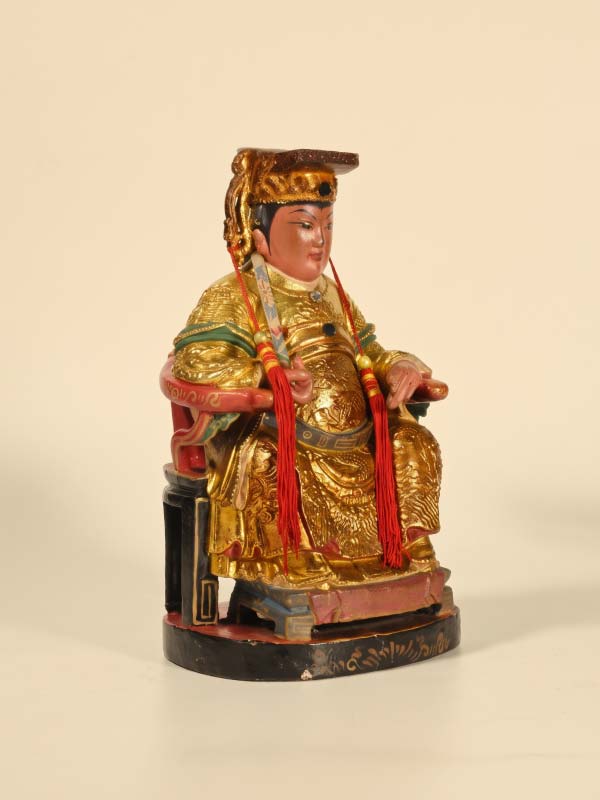
(妈祖 / 天上圣母 · Tian Shang Sheng Mu)
According to legend, the true name of the sea goddess Mazu (妈祖) was Lin Mo (林默), also known as Lin Moniang (林默娘). She was born on the twenty-third day of the third lunar month in the first year of the Jianlong (建隆) reign of Emperor Taizu of Song (宋太祖) (960 AD) and passed away on the ninth day of the ninth lunar month in the fourth year of the Yongxi (雍熙) reign of Emperor Taizong of Song (宋太宗) (987 AD). Because she closed her mouth and did not cry at birth, she was named “Mo” (默, meaning silent), with the nickname “Moniang” (默娘). Historical records indicate that Mazu (妈祖) was a descendant of Lin Yun (林蕴), the regional chief (刺史) who headed the sixth branch (第六房) of the prominent “Jiumu Lin” (九牧林) clan in Putian (莆田) during the Tang Dynasty (唐代).
From her youth, Lin Mo (林默) was exceptionally intelligent and intuitive. She began her schooling at the age of eight under a private tutor (启蒙读书). Not only could she recite texts after a single reading, but she also possessed a deep understanding of the inner meanings of the words. As she grew older, she was passionate about charity and dedicated herself entirely to public welfare. She vowed to spend her whole life doing good deeds to help others and pledged never to marry, a wish her parents respected. She deeply studied medical principles, treated people’s illnesses, and taught them how to prevent epidemics and avert disasters, earning the deep love and respect of her fellow villagers. She had a gentle disposition and a helpful heart, constantly resolving disputes for her neighbors and guiding people to avoid misfortune and pursue good luck. Whenever people encountered difficulties, they were always willing to consult her and seek her help.
Raised by the seashore, Lin Mo (林默) was also well-versed in astronomy and meteorology, and was highly skilled in water navigation. The strait between Meizhou Island (湄洲岛) and the mainland was filled with treacherous reefs. Fishing boats and merchant ships in distress within this sea area often received her rescue, leading to folk legends that she could “cross the sea on a reed mat” (乘席渡海). Furthermore, she could predict good and bad fortune, forewarning ship owners whether they could set sail, which led to her being revered as the “Divine Woman” (神女) or the “Dragon Daughter” (龙女).
On the ninth day of the ninth lunar month in 987 AD (the fourth year of the Yongxi (雍熙) reign of Emperor Taizong of Song (宋太宗)), the 28-year-old Lin Mo (林默) tragically died while saving lives at sea. However, in later folk legends, this day was regarded as the day she ascended to heaven (羽化飞升). It was said that the residents of Meizhou Island (湄洲岛) witnessed Mazu (妈祖) riding a strong wind and auspicious clouds, soaring into the bright blue sky. Ever since then, seafarers frequently claimed to see Lin Mo (林默) dressed in red attire, flying over the sea to rescue those crying out for help in distress. Consequently, enshrining statues of Mazu (妈祖神像) on maritime vessels gradually became a widespread practice to pray for safe and smooth voyages.
According to local historical chronicles of Fujian (福建) and Matsu (马祖), when the 28-year-old Lin Moniang (林默娘) of Meizhou (湄洲) lived during the Song Dynasty (宋朝), her father and brother encountered violent winds and monstrous waves while sailing near the mouth of the Min River (闽江口海域). Their boat was destroyed and they were drowning. Upon hearing the news, Moniang (默娘) dove into the sea to rescue her father and brother, but unfortunately perished. Her remains drifted with the ocean currents to Guantang Island (竿塘岛) near the Min River estuary (which is present-day Nangan Island (南竿岛) of the Matsu Islands (马祖列岛)), where she was recovered and buried on the shore by local fishermen. Because her fellow villagers back in Meizhou (湄洲) could not find her whereabouts, they believed she had ascended to heaven to become an immortal, and thus built the Meizhou Mazu Temple (湄洲妈祖庙) in her memory. Conversely, the residents of Matsu (马祖) believe that Mazu (妈祖) remains buried to this day in a stone sarcophagus within a sacred pit (灵穴石棺) inside the Matsu Heavenly Empress Temple (马祖天后宫) in Nangan Township (南竿乡), Matsu (马祖). The people of Matsu (马祖) built the temple to worship her, making it one of the most vital spiritual pillars for the local residents. The island was consequently named Mazu Island (妈祖岛).
The Mazu statue (妈祖神像) in Poh Onn Kong Temple (保安宮) is over 176 years old. A very exquisite small plaque engraved with the words “有感必应” (有感必應, meaning “Every Prayer is Answered”)—jointly donated in the year 1850 (道光庚戌年, 1850 AD) by Xu Yanquan (徐炎泉), the former leader of the Fujian Huiguan (福建會館館主), and Xiao Qizheng (蕭七政), the leader of the Hede Society (合德會會主)—is remarkably delicate.